

Logo
+90 537 731 38 61
info@aeterninvento.com
ул. Эмануила Манолова, 23А / Варна, Болгария / 9010
  • Home
  • About Us
  • Our Products
  • Contact Us
site_title

navigation

  • Home
  • About Us
  • Our Products
  • Contact Us

CONTACTS

  • +90 537 731 38 61
  • info@aeterninvento.com
  • ул. Эмануила Манолова, 23А / Варна, Болгария / 9010

follow_us

Select Language

  • UA Українська
  • EN English
  • BG Български
  • RU Русский
  • Garden protection
  • Agricultural equipment
  • Generators
  • Organic protection
  • Frost protection
  • Modular Graindryers
  • Grain Cleaning Lines
  • CHG Heat Generators
  • Diesel Generators
  • AgroKaolin Pro
  • NanoCalne
  • Wind machines
  • Smoke machines
  • AntiFrost MAX
  • LPG Grain Dryers
  • Solid-fuel grain dryers
    Full Heat
    With Cooling
  • Mobile Graindryers
  • Grain Coolers
  • Pre-Cleaning
  • Excell Series
  • Screening machines
  • Stone Separators
  • Cylindrical Triremes
  • Gravity Separators
  • Liquid Treatment Machines
  • Brushing Machine
  • Bagging Machines
  • Dehullers
  • Milners
  • Walnut Cracking Machines
  • Baudouin
    ARK-B Series
    GBB Series
  • Perkins
    ARK-P Series
    GNP Series
  • Arkem
    ARK-A Series
  • SDEC
    ARK-S Series
    GNS Series
  • Torque
    GNT Series
  • Doosan
    GNDD Series
  • Yangdong
    GNYD Series
  • Ricardo
    Ricardo
  • Mitsubishi
    GBM Series
    ARK-M Series
  • Cummins
    GBC Series
    ARK-C Series
  • Yavuz
    GNY Series

Cylindrical Trieur (Indent Cylinder)

Accurate Classification of Grain and Seeds by Particle Length in Grain Cleaning Lines

Cylindrical Trieur: Principle of Operation and Purpose

A cylindrical trieur, also known as an indent cylinder or indent cylinder separator, is specialized equipment for separating grain and seeds by particle length. Unlike air separators or sieve machines, this type of equipment does not use differences in material weight or density — separation occurs exclusively on the basis of grain fraction.

Cylindrical trieur machines occupy a key place in grain cleaning technological lines: they are installed after preliminary cleaning and before final sorting or polishing stages. The main task of the machine is to remove short and long impurities, broken grains, and foreign inclusions that cannot be separated using screens or aspiration.

The use of cylindrical tribers is relevant in the processing of wheat, barley, rice, sunflower seeds, and a wide range of other grain and oilseed crops. High sorting accuracy ensures the uniformity of the finished product and protects subsequent technological equipment from unwanted fractions.
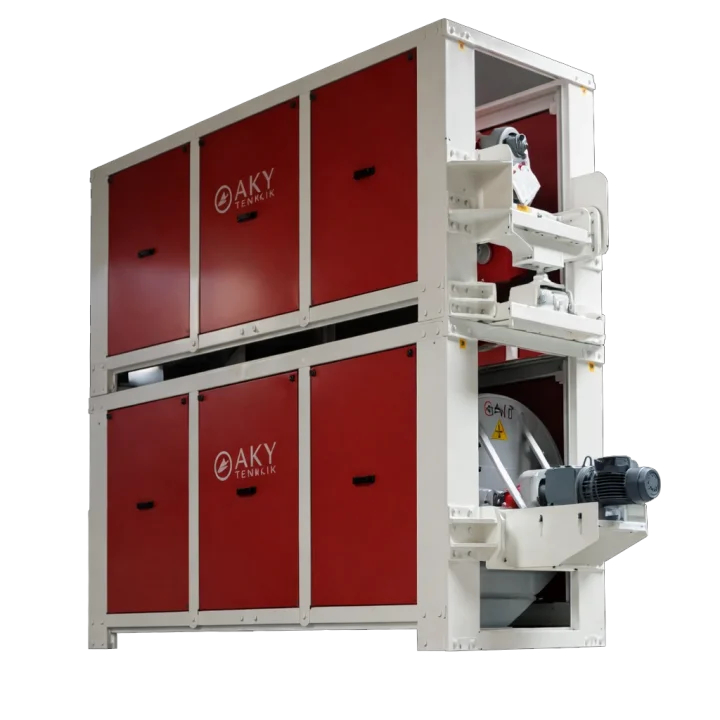
Cylindrical Triremes

# Design and Technical Characteristics of the Indentation Cylinder

The construction of a cylindrical trieur is based on a horizontally positioned rotating cylinder, the internal surface of which is equipped with precisely formed indentations—cells (indents). The geometry of each indent is calculated for specific dimensions of the crop being processed: this is precisely what determines the selectivity of grain particle capture during operation.

The regulation of the cylinder's rotation frequency and its angle of inclination allows operators to precisely adjust the separation process for various types of raw materials and required quality indicators. A drive with a frequency-controlled converter (inverter) ensures stable and smooth rotation, eliminating jerks and vibrations that could disrupt the accuracy of sorting.

System performance scales through the arrangement of multiple cylinders in a single machine or the combination of several units into multi-stage lines. This approach makes it possible to solve complex multi-fraction separation tasks without compromising accuracy at each stage.

High cell density on the working surface of the cylinder directly affects the productivity and accuracy of sorting. Industrial systems allow the use of cylindrical inserts with various indent geometries depending on the characteristics of the material being processed, which makes the equipment a universal grain cleaning tool.

Cylindrical Triremes Detail 1
Cylindrical Triremes Detail 2

The Operating Principle of a Cylindrical Trieur

The grain mass is fed into a rotating cylinder, where shorter particles or those commensurate with the cells are captured by indents and lifted along the rotation trajectory. Upon reaching the calculated lift point, the captured grains are discharged into a special tray and removed as a separate fraction.

Particles whose size exceeds the geometry of the indents are not captured by the cells and remain at the bottom of the cylinder. Under the action of inclination and rotation, they are transported along the cylinder axis and discharged through the opposite end as an independent stream.

Thus, two clearly separated material streams are formed at the output: a fraction of short particles and a fraction of long particles. This is a fundamental difference of the trieur from other grain cleaning machines — separation by shape and length, rather than by mass or aerodynamic properties.

The accuracy of separation is determined by the correspondence of the indent geometry to the size of the target crop, the correctly selected rotation speed, and the tilt angle of the cylinder. The combination of these parameters makes it possible to achieve high purity of output fractions with minimal losses of conditioned grain.

Learn more
home / Agricultural equipment / Grain Cleaning Lines / Cylindrical Triremes

Choose the right solution

Explore our product groups to find equipment that fits your needs.

Cylindrical Trieres and Indented Separators

Loading Products

feature_filters_title

no_filters_available

Our Solutions

  • Field Protection
  • Agricultural Equipment
  • Energy

Our Offices

HEAD OFFICE

ул. Эмануила Манолова, 23А / Варна, Болгария / 9010

+90 537 731 38 61

info@aeterninvento.com

logo

Menu

  • Home
  • Who We Are?
  • Our Solutions
  • Contact Us
  • Term of Use
  • |

  • Privacy Policy
  • |

  • Security Policy
  • |

  • AETERN INVENTO ALL RIGHTS RESERVED

Request Quote

quote_success
form_error